What the business behind a property marketplace needs
A property marketplace serves several parties who never sit in the same room. Agencies need to publish listings quickly, set viewing times and see who is coming. Buyers want to narrow hundreds of homes down to five, understand the real price and monthly costs, and tell an agent they are serious. Sellers want a first idea of value and a call from someone local. The operator needs agency accounts, billing, moderation and a record of who did what.
Each of these users needs a different screen, and they share one set of data. A listing created by an agent feeds the search, the map, buyer alerts and the agent's own statistics. A viewing registration made by a buyer has to reach the agent at once. The software also carries the local rules on what a listing must show and how offers are made.
How the Kattolyhty demo works
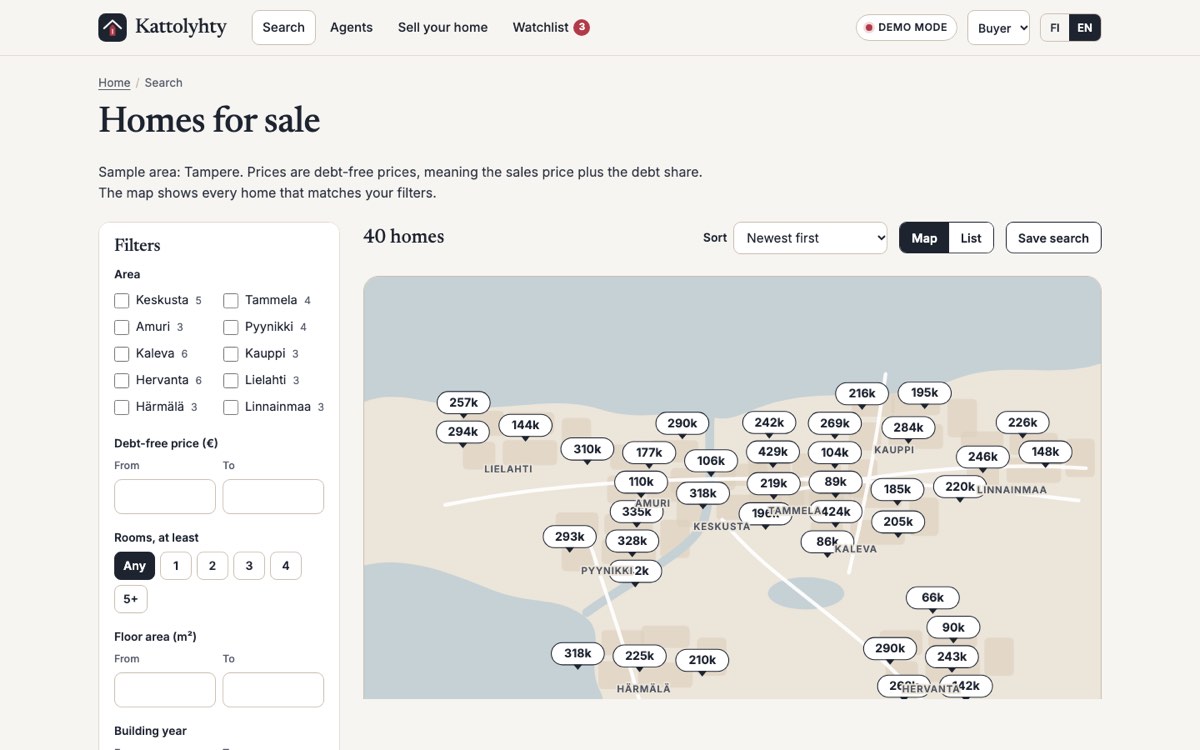
Kattolyhty is a fictional marketplace that VirtueInfo created for this demo. It is not a client, and its agencies, agents, housing companies and prices are sample data. The demo has forty listings, eight agents and ten Tampere districts, with Finnish screens at the root and English under its own path. A demo-mode badge and a buyer or agent role switch sit in the top bar.
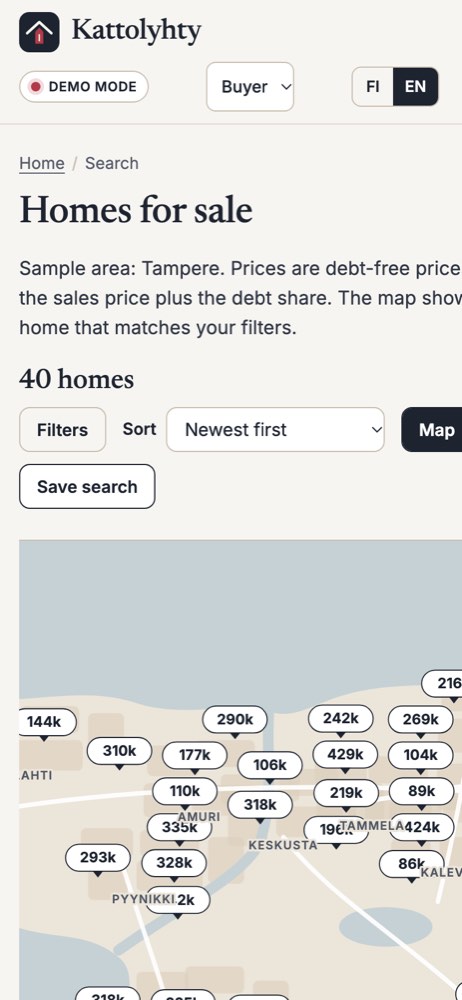
The home page opens with a map, a quick search and the newest listings. A worked example shows how the debt-free price is built from the sales price and the debt share, and how maintenance and financing charges add up to the total monthly charge.
The search screen has the filters a Finnish buyer expects: area, debt-free price range, rooms, floor area, building year, energy class, owned or leased plot and building type. Results switch between a list and a stylised map with price pins, can be sorted by price, price per square metre, size or newest first, and can be saved as a search.
Each listing page shows an illustrated gallery, key facts, the price breakdown, monthly charges with maintenance per square metre, and housing company details including past and planned renovations. A buyer can register for a viewing and send an offer request. As they type the debt-free price they would pay, the form shows it as purchase price plus debt share. It refuses an offer below the debt share and says plainly that this is a request, not a binding offer. With the agent role selected, a panel shows sample figures for views, saves, registrations and offer requests on that listing.
The sell flow takes area, building type, floor area, year built, condition and plot, and returns an indicative debt-free price with a range. It also prints the formula, so the seller sees why the number is what it is. The watchlist keeps saved homes, saved searches with alert frequency and channel, and viewing registrations, all stored in the browser and cleared by a reset button. The agents screen filters agents by district.
What a production build adds
The demo keeps everything in the browser. A live marketplace runs on a server with a database and a search index, so filters and the map stay fast with many thousands of listings. Listings arrive through an import from agency systems, with a manual editor alongside. The map uses real geocoding and map tiles, and photos go through an image service that resizes them for phones.
Accounts and roles carry most of the security work. Buyers sign in to keep their watchlist across devices. Agents see only their own agency's listings, registrations and offer requests, and agency admins manage their staff. Platform admins handle moderation and billing. Buyer names, phone numbers and financing details are personal data under the GDPR, so we limit who sees them, host in the EU and delete them on a schedule. Alerts run from a job queue that sends email or push messages. Changes to prices, listing status and offers are written to an audit log.
Market notes
Finland
Finnish buyers compare homes by debt-free price, so it has to come first, with the sales price and debt share beside it. Listings are expected to show the monthly charges, the energy class with its certificate version, plot ownership and the housing company's renovation history, and agents show their LKV qualification. Sellers' documents such as the property manager's certificate and the maintenance needs report are part of every flat sale, and housing company shares are moving from paper certificates to the national electronic housing register. Finnish comes first, Swedish matters in bilingual areas, and English suits international buyers. Large national portals already exist, so a new platform usually needs a defined niche.
India
Buyers expect prices in lakh and crore and quick contact over WhatsApp. New projects normally display their RERA registration number.
USA
Listing data usually comes through an MLS feed with its own display rules. Fair housing rules apply to advertising wording.
Canada
Brokerage is regulated by each province. A Québec platform needs French.
Australia
Agent licensing and price guide rules are set by each state, so the listing form should follow the state of the property.
How we run a project like this
We start with discovery: who the users are, which agencies will feed listings and in what format, and what the operator earns from. From that we agree a phased plan. The first release is usually search, listings and viewing registration, with valuations, alerts, agency billing and analytics in later phases. A dedicated team of a project manager, designers, developers and a tester stays with the product, and the build sits under our custom application development service.
After launch we handle hosting, monitoring, updates and new features as the marketplace grows. Tell us who your marketplace is for and where the listings will come from through our contact page, and we will reply with a proposal and a quote.