What a lending marketplace needs from its software
A peer-to-peer lending platform serves two groups whose interests pull in opposite directions. Borrowers want a short application and a quick answer. Lenders want clear risk information, small minimum shares and a record of every payment they receive. The operator sits between them and carries the obligations: identifying customers, assessing credit, warning about risk and keeping accurate books.
That gives the software a clear set of jobs. It has to take an application, check identity and credit records with the applicant's consent, and reach a decision that can be explained. It has to list approved loans without exposing personal details, let lenders fund any share and track funding until a loan is full. Once a loan pays out, it has to run an annuity schedule, take each instalment and divide it between lenders without losing or inventing a cent. Behind all of that, staff need roles for credit review, customer service, finance and compliance, each seeing only what their job requires.
How the Lainakaari demo works
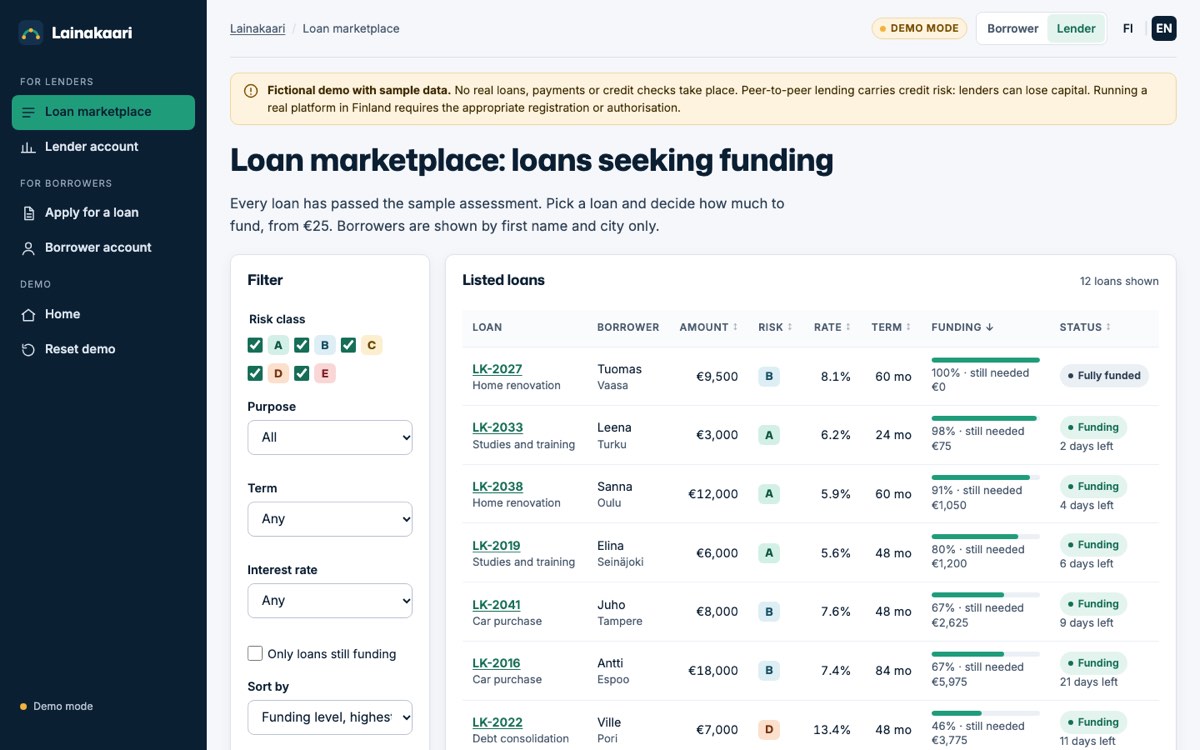
Lainakaari is a fictional product and company created by VirtueInfo. All loans, people and figures are sample data, nothing is sent to a server and no money moves. The demo runs in the browser and keeps its state on your own device, with a reset button to start again. A switch in the header moves between the borrower and lender views.
Borrower side
The application has five steps: loan, finances, identification, consents and assessment. The borrower picks an amount between €1,000 and €20,000, a term of 12 to 84 months and a purpose, then enters net income, housing costs, other costs and existing loan payments. The identification step is labelled as a sample and never asks for an identity code. The assessment gives a risk class from A to E and a sample rate, and lists the points behind it, so the applicant can see why the answer came out as it did.
The borrower account shows a €6,000 renovation loan over 36 months. Pressing the pay button settles the next instalment and shows a table of how it was divided between every lender.
Lender side
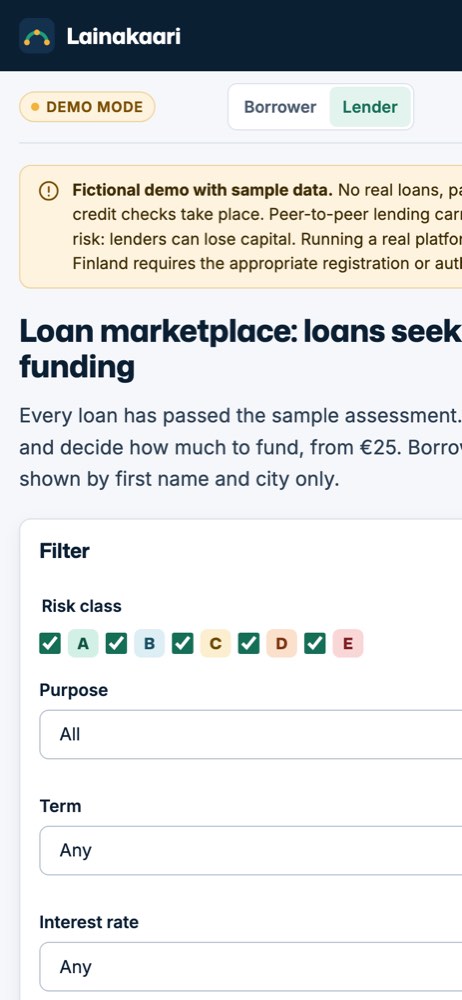
The marketplace lists twelve sample loans with risk class, rate, term and funding level. Lenders filter and sort, and borrowers appear by first name and city only. Each loan page shows funding progress, lender shares by ID and an investment calculator from €25 that draws the monthly cash flow before fees and tax. The lender account holds a small portfolio, the latest payments received and a chart of how the last instalment was split.
The arithmetic, in the open
The instalment comes from the standard annuity formula, rounded to the cent. Each month's interest is the outstanding balance times the monthly rate, rounded to the cent, and the last instalment clears whatever balance remains. The split to lenders uses a largest-remainder rule, so the shares always add up exactly and the same split comes out every time. Every screen explains these rules in plain words.
What a production platform adds
The demo shows the screens and the calculations. A live platform wraps them in the parts that make it safe to run with real money.
- Strong electronic identification and consented checks against credit and income records
- A connection to your payment provider and client funds account, with daily reconciliation
- A ledger where every movement is recorded once and balances are derived from it
- Staff roles, two-person approval for sensitive actions and an audit log of who changed what
- Data protection by design: minimal personal data, retention rules, access logging and deletion on request
- Reminders, overdue handling, collection hand-off and annual statements for lenders' tax returns
- Reports for management and the regulator, plus monitoring and backups
The calculation code stays the same. It moves to the server, where it is tested against fixed cases so a rounding change cannot slip into production unnoticed.
Market notes
Finland
A real platform needs the appropriate registration or authorisation, and the demo says so in its footer. Intermediaries of consumer peer-to-peer loans must register in the register kept by the Financial Supervisory Authority under Act 186/2023, and other business models may need a licence. Take your own legal advice on which applies. Finnish users expect strong electronic identification through their bank or mobile certificate, so the application should start there. Write in Finnish first, with Swedish where your audience needs it and English for international lenders. The demo is Finnish-first, with English under /en/.
India
Peer-to-peer lending is a regulated activity overseen by the Reserve Bank of India. Users expect UPI for repayments and mobile-first screens.
The USA
Federal and state rules both apply to lending and to offering loans to investors. Plan for legal review before you design the lender side.
Canada
Investor-facing platforms generally fall under provincial securities regulators. Québec users expect French alongside English.
Australia
Consumer credit and investment offers generally require licences from the national regulator. Your advisers will tell you which ones fit your model.
How we run a lending platform project
We start with discovery: your credit policy, your regulatory position as your advisers describe it, your payment flows and the reports you owe. From that we agree the first release, usually one borrower journey, one lender journey and the back office to support them. We build in phases, each ending in a working version you can test with sample data, the way the demo works now.
A dedicated team of developers, a designer and a tester stays on the project from start to launch. After launch we handle maintenance, security updates and changes as your rules evolve. Our custom application development page explains how we work on platforms like this. To talk through your plans or ask for a quote, contact us.