What a business directory operator needs from the platform
A business directory has three audiences with different jobs. Searchers want to find a supplier by name, area or industry and trust that the company still exists. Companies want to say what they do and when they are open, because a register entry alone tells a customer very little. Developers and data buyers want the records in their own systems, in a format that stays current.
The operator has jobs of its own. It has to import a large public data set, keep it in step with the register every day and respect the licence terms. It has to verify that a person claiming a profile can represent the company, and moderate what companies write. It needs roles for support staff and editors, usage figures for the API and a clear line between official data and the directory's own content.
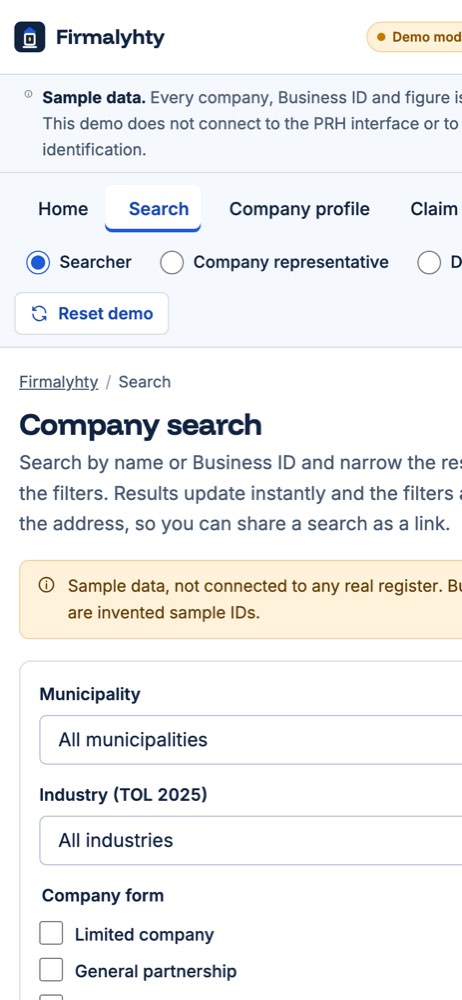
How the Firmalyhty demo works
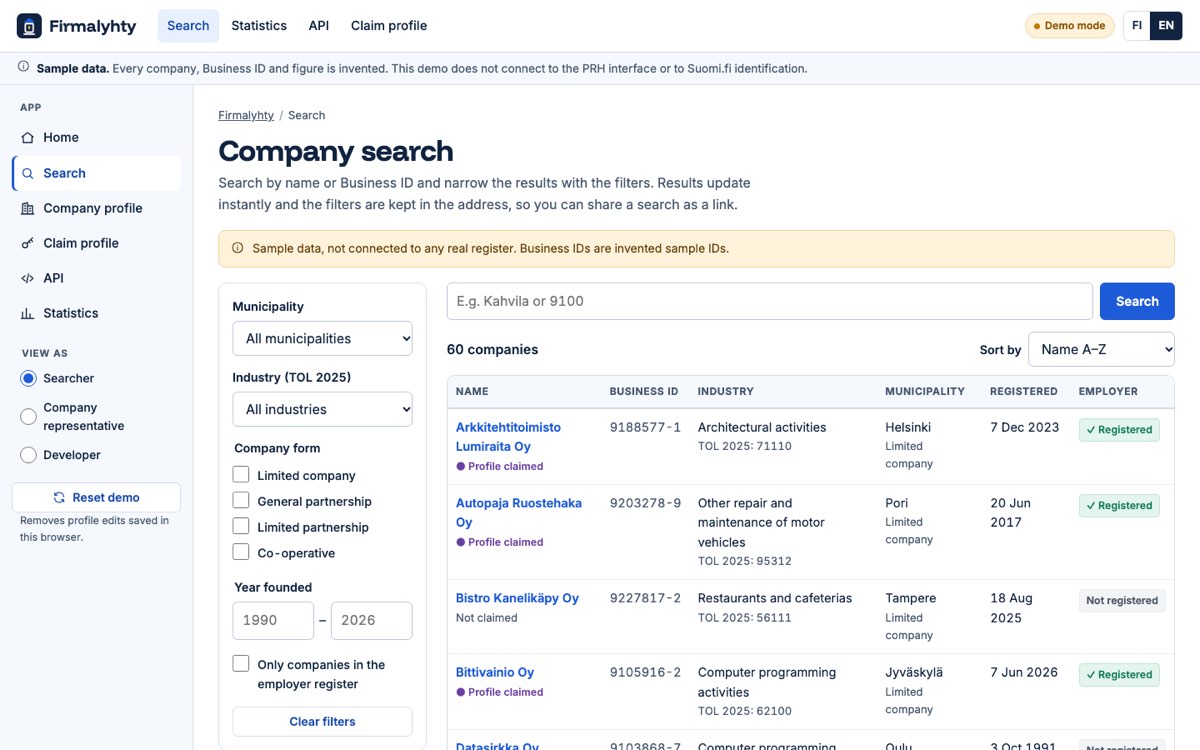
Firmalyhty is a fictional product created by VirtueInfo. Its 60 companies and their Business IDs are invented, and the demo does not connect to the Finnish register or to Suomi.fi identification. Finnish is at the root and English under /en/. A role switcher in the sidebar changes the view between searcher, company representative and developer, and a reset button clears profile edits saved in your browser.
Search
The search screen filters by municipality, industry, company form, founding year and employer register status, and sorts by name, age or most recent change. Results update instantly, and the filters live in the address bar so a search can be shared. Industries use the five-digit TOL 2025 codes that the Finnish register adopted at the start of 2026, and the product page explains that searches with old codes are routed to the matching new ones.
Company profiles and claiming
Each profile shows register data with a blue edge and company-added content with a purple edge. The register panel lists Business ID, company form, registered office, main industry, the four register entries and the date of the last change. Below it sit the company's own description, opening hours and a map placeholder. A developer panel shows the same record as the API returns it.
Claiming takes four steps. The representative picks the company and goes through a sample identification, confirms their role (managing director, board member, procuration holder or mandate holder), writes a description of 40 to 600 characters with a live counter, sets opening hours and previews the result before publishing.
API and statistics
The API page documents company search, single-company lookup and a nightly change feed, with rate limits and the 429 response for clients that exceed them. A try-it box builds a sample response from any Business ID in the demo. The statistics page draws new companies per month and companies by industry and region, and each chart can switch to a table.
What a production platform adds
The demo shows the data model and the screens. A live directory needs the machinery behind them.
- A full import of the register data and a nightly job that applies only changed records, with alerts if a run fails
- Real identification and representation checks for profile claims
- Moderation tools, an edit history for every profile and an audit log of staff actions
- API keys, usage metering, rate limiting and, if you charge for data, billing
- Search that stays fast across hundreds of thousands of companies
- Data protection for the personal data of company representatives, with retention and deletion rules
- Source attribution and licence terms shown where the data is used
Market notes
Finland
The Finnish Patent and Registration Office publishes open company data through an interface updated daily, under CC BY 4.0. The data covers companies and co-operatives but has no phone numbers or email addresses and leaves out sole traders, which is why company-added content matters. Its terms ask services to credit the source and not to look like the authority's own service, and the demo follows both. Representatives sign in through Suomi.fi, roles can come from the Trade Register or Suomi.fi mandates, and the interface should be in Finnish, Swedish and English.
India
Company master data comes from the Ministry of Corporate Affairs, and GSTIN is a common second identifier. English plus regional languages suits most audiences.
The USA
Companies register by state, so a national directory combines many sources with different terms.
Canada
Federal and provincial registries both hold company records. Québec users expect French.
Australia
The Australian Business Register offers ABN lookups. Check the reuse terms before building on them.
How we run a directory platform project
Discovery covers your data sources, their licences, who your paying customers are and how profiles will be verified. We usually ship search and profiles first, then claiming, then the API and statistics, with each phase working on real register data before the next begins. A dedicated team stays from the first import to launch and then maintains the platform, including the nightly import that has to run every day without attention.
Much of this work is connecting systems, so our application integration page is a useful next read. To discuss your directory or ask for a quote, contact us.