What a local food platform has to do for the people who run it
A local food platform has three groups of users with different days. Households want to see what the farms have this week, order before the deadline and know exactly where and when to collect. Farms want one list on Thursday morning that says how much to harvest and which bag goes where, instead of a week of messages to count by hand. The coordinator, often one person with a van, wants pickup times that hold and a route that does not leave customers waiting in a dark car park.
The software has to follow the week's rhythm. Farms open their products on Monday, ordering closes at a fixed time, and stock must never be sold twice. After the cut-off the orders turn into harvest quantities, packing lists and a delivery timetable. Payments have to reach each farm, and the operator needs a record of every sale.
How the Satosilta demo works
Satosilta is a fictional platform that VirtueInfo created to show this kind of build. It is not a client. Its farms, products, orders and prices are sample data. The demo is bilingual, with the Finnish screens at the root and English under its own path.
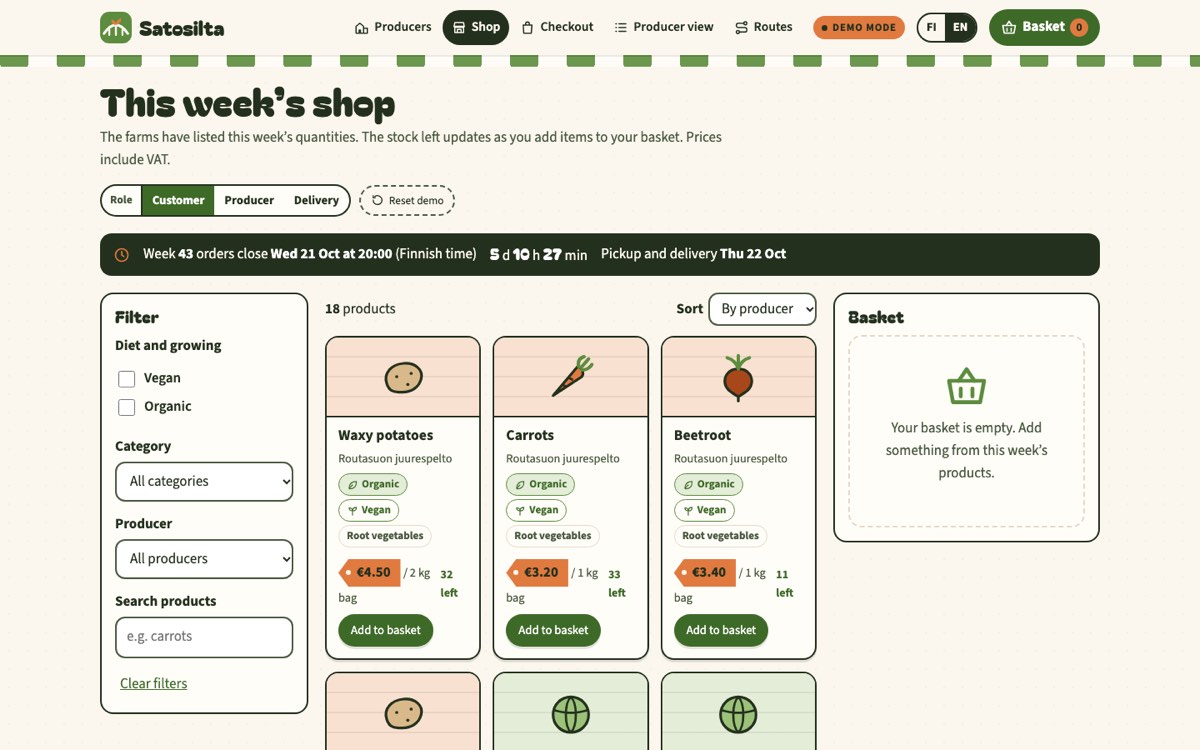
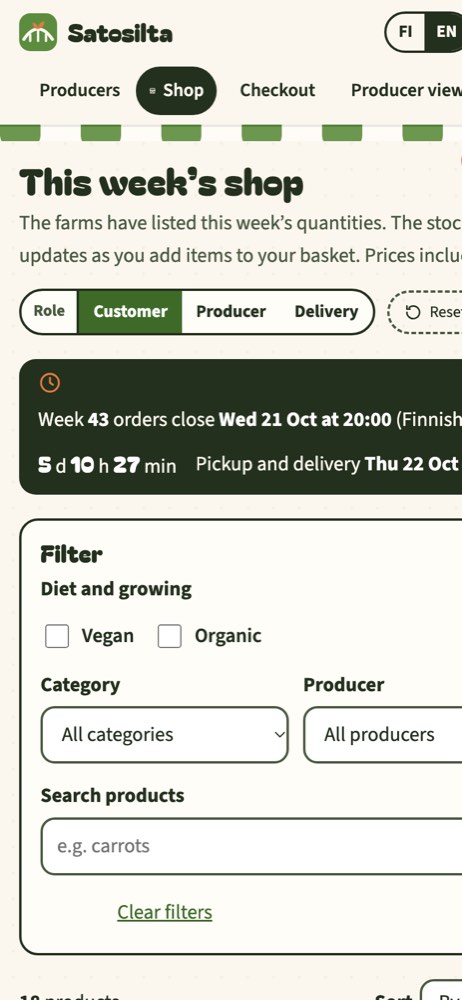
The home page explains the week in four steps and shows a live countdown to Wednesday at 20:00. It counts in Helsinki time wherever the visitor is. The producers screen lists the farms from nearest to furthest, measured from whichever pickup point the visitor picks.
In the shop, each product card shows the unit, the price including VAT and how many are left. Adding items lowers the stock count straight away, and when a farm's batch is gone the product shows as sold out.
Checkout has three steps. The customer picks one of five pickup points, each with its own Thursday window, or home delivery, which the demo checks against the 13xxx postcode area. The delivery fee is shown before the order is placed and drops away above a set basket value. The payment step is marked as a placeholder and nothing is charged.
The producer view is the signature screen. Choose a farm and it lists orders by product and by pickup point, the sales total and the kilos to harvest, worked out as units times unit weight plus 5% for sorting. Packing labels are sorted by pickup point and time and print from the browser. An order placed at checkout is stored in that browser and appears here with an orange label, so a visitor can follow one order from basket to label.
The routes screen shows two Thursday routes on a schematic map, one for the pickup points and one for home deliveries. Moving a stop recalculates distance, drive time and every pickup window. The optimise button picks the nearest next stop each time, and the screen warns when the order no longer matches the published timetable.
What a production build adds
The demo runs entirely in the browser. A real platform moves the data to a server with a database, and the cut-off and stock checks run there, so two customers cannot buy the last tray of eggs at the same moment. Customers, farms, the coordinator and drivers get their own accounts and permissions. A farm sees only its own orders and settlements, and the coordinator sees everything.
Payments go through a provider that can split one customer payment between farms and the platform. Customer names, phone numbers and addresses are personal data under the GDPR, so we keep them to what delivery needs, host in the EU and set a retention period. Route timing uses road distances from a routing service, and pickup reminders go out by SMS or email. An admin area covers areas, pickup points, delivery days and fees. Changes to prices, stock and orders are written to an audit log.
Market notes
Finland
This model is familiar in Finland, where many households already pre-order from local farms and collect at an agreed time and place. Finnish comes first, Swedish matters in bilingual municipalities, and English helps international residents. Customers expect Finnish online bank payments, cards and mobile payment at checkout, with prices shown including VAT. Farms selling direct still have food safety and registration duties with the Finnish Food Authority and municipal food control, so the farm profile can hold those details. Only show an organic label when the farm is in the organic control system, and treat chilled goods such as meat and eggs with a cold chain plan for each pickup point. Online shops also fall under the accessibility requirements that took effect in 2025, so we build to WCAG from the start.
India
Customers expect UPI at checkout and order updates on WhatsApp. Food sellers usually display their FSSAI registration number, and prices are shown in rupees with GST handled per item.
USA
Sales tax on food and cottage food rules vary by state, so check both before launch.
Canada
Prices are in Canadian dollars, and most basic groceries are zero-rated for GST/HST. A Québec service needs a French version.
Australia
Show prices in Australian dollars including GST, noting that most fresh food is GST-free.
How we run a project like this
We start with discovery: workshops with the coordinator and two or three farms to map the week, the products, the pickup points and how money flows. That gives a scope and a first release, usually the shop, checkout and producer lists, followed by payments, routes and further areas in later phases. A dedicated team of a project manager, designers, developers and a tester works with you through each phase, and the work sits under our e-commerce solutions service.
After launch we look after hosting, updates and changes to the season's setup. Send us how your farms sell today and which areas you want to cover through our contact page, and we will reply with a proposal and a quote.