What tile buyers need from a manufacturer's website
A tile factory sells to three kinds of buyer, and each arrives with a different question. A showroom owner wants to know your collections, your dealer terms and how fast a reorder reaches the shop. A builder or architect has a bill of quantities and needs box counts, batch availability and freight to site. An importer abroad wants FOB prices, container loading and the documents that travel with the shipment.
All three share one worry. A slab that looks calm on a display board can look busy across a whole room, and an order that falls two boxes short on the last day of laying causes a shade mismatch. A good website helps buyers see the floor before they order and count the boxes correctly, then sends a complete enquiry to your sales desk.
So the site has to show each collection with its sizes and packing, let a visitor try a tile in a room, work out quantities, and collect an enquiry your team can price without five follow-up calls.
How the Terrafina demo works
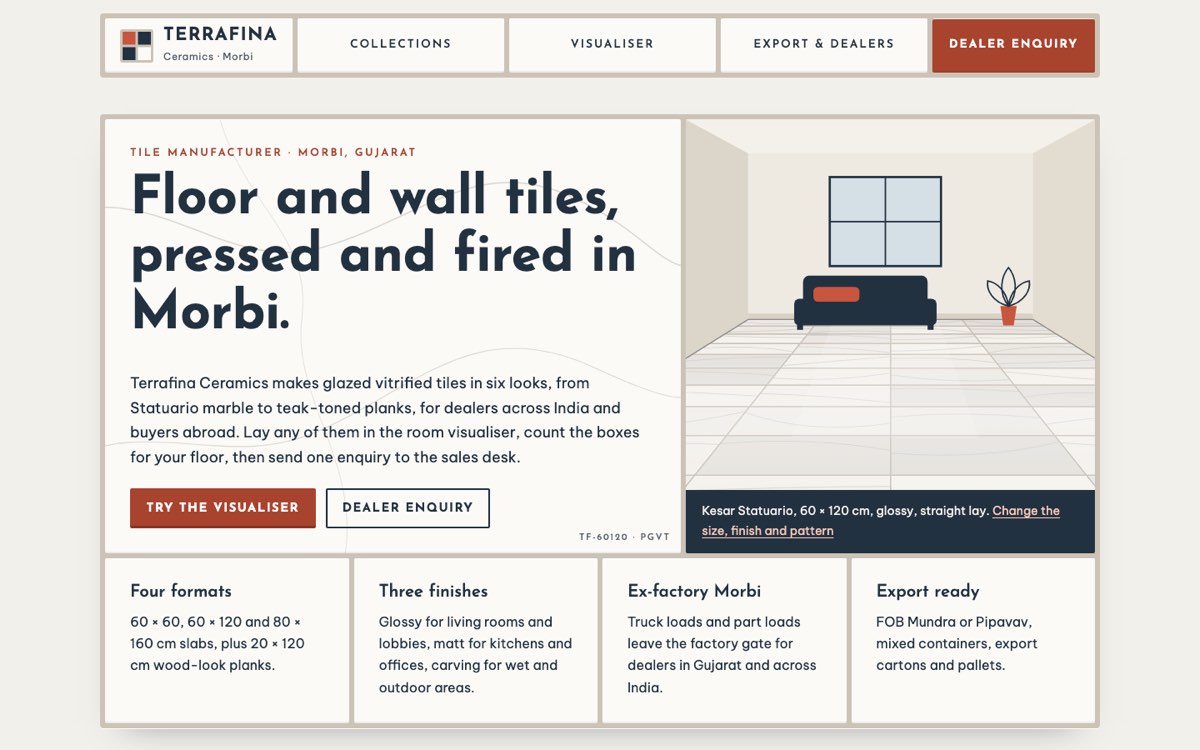
Terrafina Ceramics is a fictional business that VirtueInfo created for this demo. It is not a client, and its phone number, GSTIN, IEC and prices are placeholders. The site works fully, so you can use it the way a dealer would.
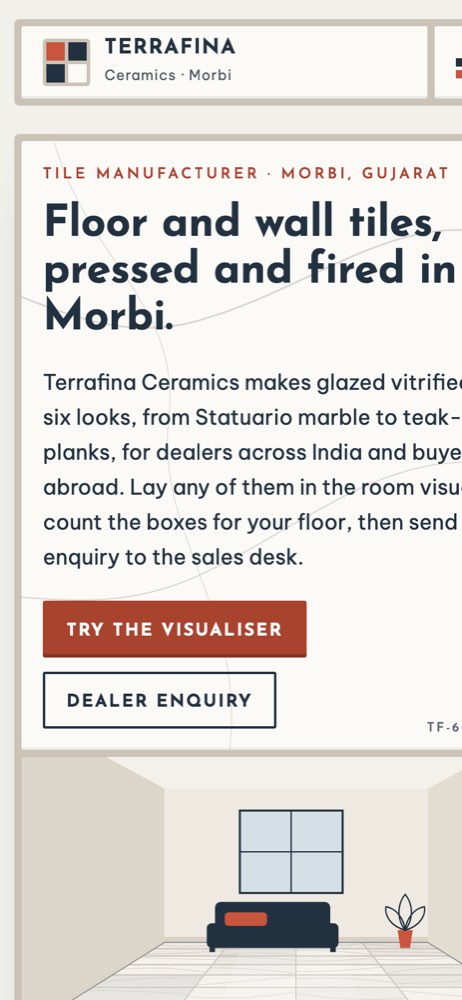
The home page introduces six looks in glazed vitrified tile, from a Statuario marble look to teak-toned wood planks, along with the four formats, three finishes and the ports the factory ships from. The collections page lists each look with its finish, sizes, thickness, best use and a "from" price per square foot and per box. A packing table below shows pieces per box, coverage and box weight for every size.
The signature feature is the visualiser. It draws a 4.8 by 6 metre living room and lays the chosen tile across the floor, tile by tile, in perspective. Visitors switch the collection, the size, the finish and the laying pattern (straight, brick offset or diagonal) and the room redraws at once.
Below the room sits the box calculator. The visitor enters room length and width in feet or metres and picks a wastage allowance, which moves automatically when the laying pattern changes. The result shows floor area, order area, boxes, pieces and a sample ex-factory cost. One link then opens the dealer enquiry form with the collection, size, finish, pattern and box count already filled in.
The export and dealers page explains FOB quotes from Gujarat ports, mixed containers, export cartons, pallets and the documents sent with each shipment. For dealers it lists display boards, a sample kit, a price list with GST shown separately and reorders on WhatsApp. The enquiry form asks the buyer type, company, city or country, WhatsApp number and an optional GSTIN, with checks in the browser before it sends.
Local and product SEO built in
The demo uses schema.org Organization markup with the factory town, the cities it supplies, sales hours and the languages the sales desk speaks. Each collection carries Product markup with a unit price per square foot, and the export page describes the export and dealership programmes as services.
Page titles follow what buyers search for, such as "tile manufacturer Morbi" on the home page and "tile visualiser and box calculator" on the visualiser page. The business name, phone and address match what you would put in your Google Business Profile, so the listing and the website agree.
The site is plain HTML, CSS and a small script, with self-hosted fonts and tile illustrations drawn in code instead of large photos, so it loads quickly on a phone in a showroom. We keep the Terrafina Ceramics demo out of search, since the business does not exist. Your own tile manufacturer website goes live fully indexable, with a sitemap submitted on day one.
Notes for each market
India
Dealers expect prices in rupees per square foot and per box, with GST and freight stated separately. Showing your GSTIN in the footer is common practice, and many reorders happen on WhatsApp, so the number belongs in the header and on the enquiry page.
USA
Distributors and contractors in the US think in square feet and cartons, and expect US English spelling. Product pages should state material, thickness and finish clearly, and import buyers will want to see your export documents and how samples are sent.
Canada
Canadian buyers work in both square feet and square metres, so the calculator can show both, as the demo already does. If you sell into Québec, a French version of the collection and enquiry pages is worth planning from the start.
Australia
Australian builders and importers work in square metres and use British spelling. Container shipments and slip resistance for wet and outdoor areas come up early in enquiries, so finish descriptions should say where each tile can be laid.
Finland
Finnish importers often read English well, but a Finnish version of the main pages helps, and Swedish is an official language too. Prices in euros, metric units throughout and clear notes on frost resistance for outdoor tiles suit the market.
What we deliver and how the project runs
We design the site around your brand and your catalogue, using your real collections, sizes, packing data and price policy. The visualiser and calculator are set up with your designs and carton figures. Enquiries go where your team works: email, a WhatsApp number or your CRM, with dealer, project and export requests routed separately if you want.
At hand-over your team gets access to update collections and prices, and we stay on for hosting, updates and new features through our maintenance service. This kind of work sits within our custom application development service, since the visualiser and calculator are small applications in their own right.
To get a quote, send us your catalogue and a note on who buys from you through our contact page.