What engineers and buyers need from a machine shop's website
People who visit a CNC shop's site arrive with a part in mind. A design engineer wants the work envelope, the tolerance you hold and the materials you stock before sending a STEP file. A maintenance planner has a broken shaft on the bench and needs a phone number and a date. A quality or purchasing lead wants to know about first article reports, mill certificates and heat-number traceability.
None of them wants a gallery of shiny parts with no numbers. They want to rule your shop in or out quickly, then send an RFQ that gets a usable reply.
So the site has precise jobs. It must list the machines and their capacities, state tolerances and finishes plainly, show the materials you cut, explain inspection and paperwork, take a quote request with files and a date, and say what work you do not take.
How the demo handles it
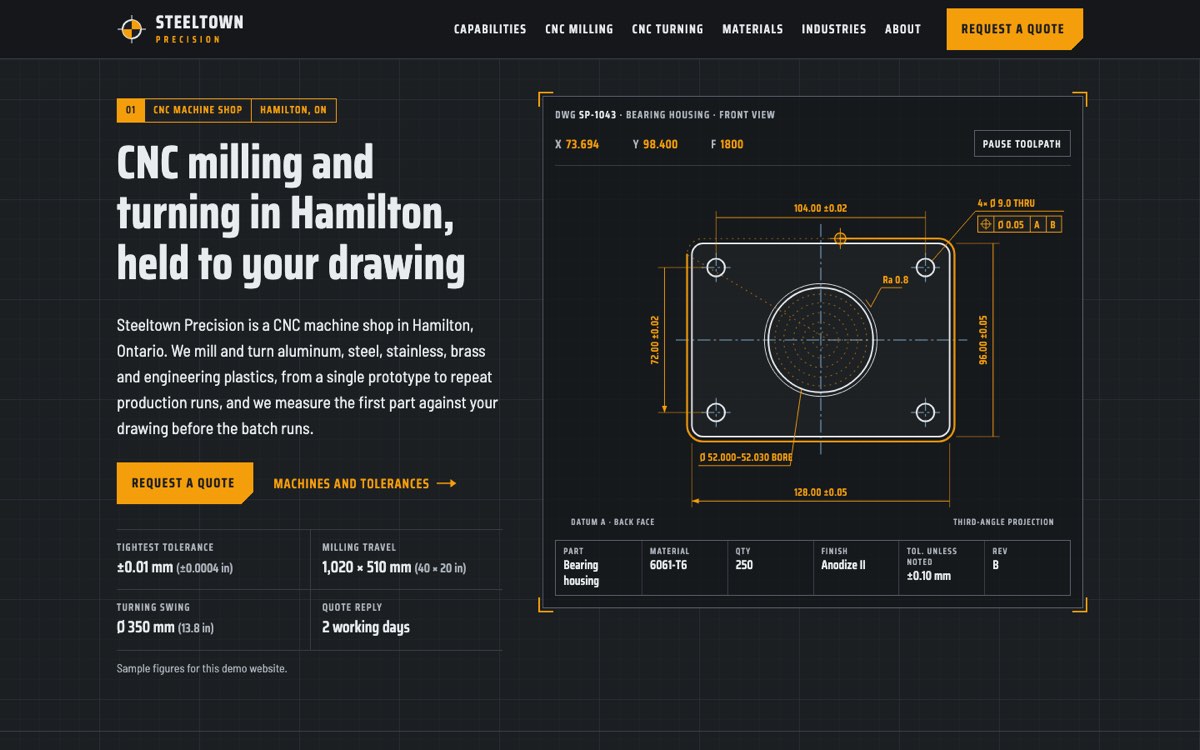
Steeltown Precision is a fictional shop that VirtueInfo created for this demo. It is not a client. Its phone number, team, machine figures and reviews are samples, and the site labels them that way. All tools on the site work, so you can try them as a buyer would.
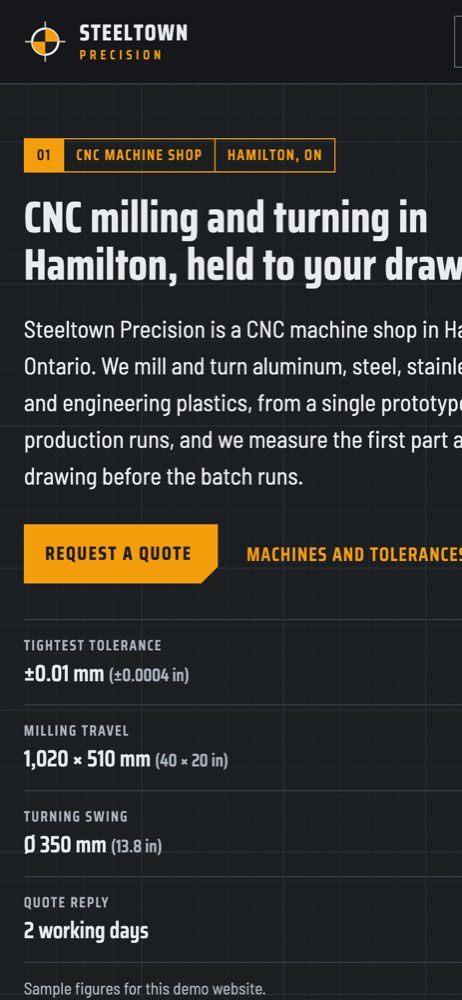
The home page opens with four figures: tightest tolerance, milling travel, turning swing and quote reply time. Beside them sits a part drawing where a cutter slowly follows a toolpath while a digital readout shows the coordinates. That animation is the signature feature. It pauses on request, stops when off screen and shows a still frame for anyone who prefers reduced motion. The milling and turning pages carry their own drawings with the same effect.
Further down, a routing section lays out the job as a shop traveller, from drawing review and written quote through first article and production to delivery.
The Capabilities page has a full machine list, a tolerance and surface finish table, and an inspection section listing the CMM, gauges and the documents supplied. The milling and turning pages explain which axis count or lathe suits a part and give six design tips each, such as adding a thread relief or keeping pockets shallow.
The Materials page holds 24 grades with strength, density, machinability and typical uses. Visitors filter by family, by need (food equipment, weldable, high temperature and more) or by text, and the filters are kept in the address so a link can be shared. Each row has a "Quote in" link that preselects the grade on the RFQ form.
The Request a Quote form checks each required field, lists attached drawing names and works out the working days to the needed-by date, marking short deadlines as rush jobs.
Local SEO built in
Every page carries schema.org structured data for an Organization and LocalBusiness, with opening hours, a contact point and the cities and regions served. Milling, turning, inspection and finishing are marked up as Service items in an offer catalogue, and inner pages have breadcrumbs.
Page titles target the searches buyers make: "CNC machine shop in Hamilton, Ontario", "CNC milling services in Hamilton" and "request a CNC machining quote". The About page names the towns covered for pick-up and delivery, from Stoney Creek to Oakville. The name, phone and hours match your Google Business Profile.
The drawings are vector graphics written in code, with no photos, and the fonts are self-hosted. Pages are light even on a plant floor connection. The demo is kept out of search results because the shop is fictional. We keep the Steeltown Precision demo out of search, since the business does not exist. Your own CNC machine shop website goes live fully indexable, with a sitemap submitted on day one.
Notes for each market we serve
India
We write in Indian English, quote in rupees and show your GSTIN in the footer. Buyers often send drawings and follow up on WhatsApp, so the RFQ page can carry a WhatsApp button. Metric-only figures suit most Indian customers.
USA
We switch to American spelling and list inch figures first, with metric in brackets. Buyers in aerospace and defence supply chains look for quality certificates and registrations, so those get their own section. Prices are in US dollars.
Canada
The demo is already Canadian: Canadian spelling, metric first, prices in Canadian dollars and courier service to the United States. Shops selling into Québec can add a French version of every page. Your business number and quality certificates sit on the About page.
Australia
We use Australian spelling, metric units and prices in Australian dollars with GST. Your ABN goes in the footer. Mining and agriculture repair work is common, so the industries page can lead with breakdown parts.
Finland
We build the site in Finnish, Swedish and English, because many Finnish shops sell to Swedish and German customers. Prices show in euros, and your business ID sits in the footer. Material grades can show EN designations alongside the others.
What we deliver and how the project runs
We design to your brand and write the copy with your estimator and shop lead, from your real machine list, materials and quoting sheet.
RFQs go where your team works: email, WhatsApp or your CRM, with drawings stored securely and linked. We can connect the form to your ERP or job tracking system if it accepts imports.
At hand-over you get the code, the hosting setup and notes on updating machines and materials. We build tools like the materials filter as custom application development, so they follow how your shop quotes.
Send us your machine list and a sample RFQ, and ask us for a quote.