What buyers and sellers need from a real estate website
A buyer moving from another state wants to filter homes fast, see where they sit on a map and understand the monthly cost before booking a flight. A first-time buyer wants HOA dues and local taxes explained, and an agent who answers in writing. A long-time owner wants a price with the reasoning behind it.
So the site has a few jobs. It must let people search and compare homes, with the facts that change a decision: floor plan, size, year built, taxes, HOA, parking. It must turn interest into a request with enough detail for the right agent to reply the same day. And it must rank for the neighborhoods you work, because most searches start with an area name.
How the demo handles it
Summit & Key Realty is a fictional Denver brokerage that we created at VirtueInfo to show this kind of site. It is not a client. The listings, prices and agents are samples.
Search and map
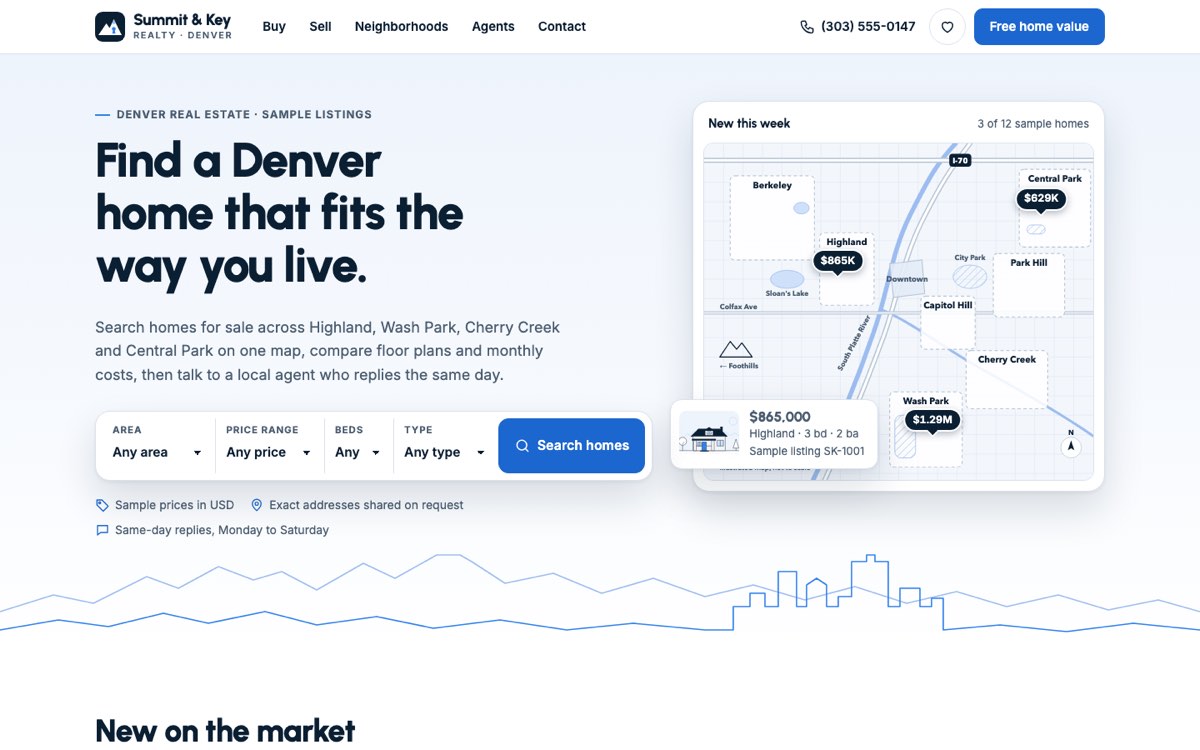
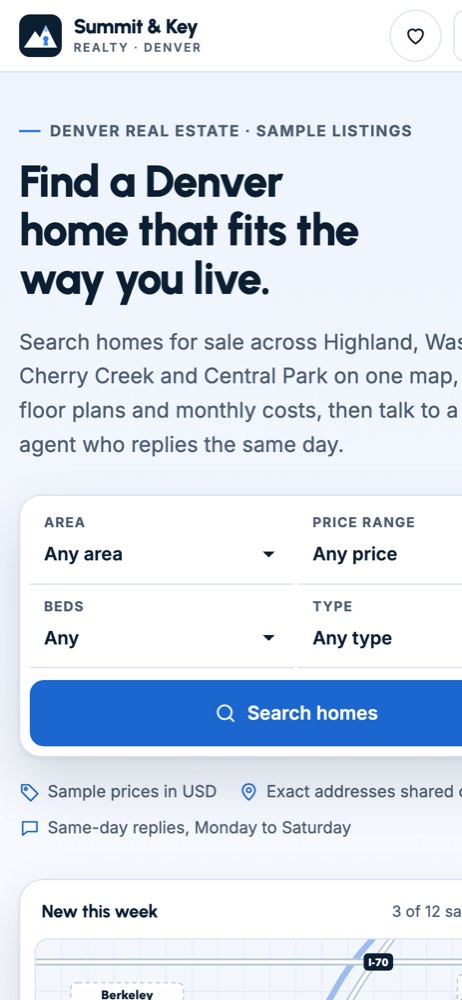
The home page opens with a search bar for area, price, beds and type. The Buy page lists twelve sample homes with sticky filters for area, price range, beds, baths and home type, plus sorting by newest, price or size. The filters are written into the URL, so a buyer can send a search to their partner and it opens the same way. Each map pin is linked to its listing card: hover a pin and the card lights up, and the other way round. On phones a floating switch moves between the map and the list. Visitors can save homes with a heart, and the saved list stays in their browser for the next visit.
Listing pages
Each of the three full listing pages has an illustration, a floor plan with room sizes, a facts table and a description. A mortgage estimate lets the buyer change the down payment, rate and term and see principal, tax, insurance and HOA dues as one monthly figure. Next to it, a book-a-viewing form asks for a day, a time window, an in-person or video tour and, optionally, the financing position.
Sellers, neighborhoods and agents
The Sell page has a three-step valuation request: the home, the owner's plans, then contact details. The Neighborhoods page has a clickable illustrated map and seven area profiles covering the homes, daily life and what to check before buying. The Agents page shows four agents with their areas, languages and a license number placeholder. Every "Ask a question" link opens the contact form already filled in with that agent, and listing links fill in the listing ID.
Local SEO built in
The demo marks the business up as a schema.org RealEstateAgent with its city, the neighborhoods it serves, opening hours and phone number. Listing pages carry RealEstateListing markup with beds, baths, floor size and the asking price as an offer. The Sell page has Service and FAQ markup, and the neighborhood guide lists each area as a place.
Each page targets one search: homes for sale in the city, a neighborhood guide, home valuation, agents in the city. The name, phone, hours and service area match what you show on your Google Business Profile, so search engines see one consistent business. Self-hosted fonts, SVG artwork and light JavaScript keep pages fast on a phone.
We keep the Summit & Key Realty demo out of search, since the business does not exist. Your own real estate agent website goes live fully indexable, with a sitemap submitted on day one. A client site launches fully indexable, with a sitemap and the markup above filled in with your real details.
Notes for your market
India
We usually build in English with a Hindi or regional-language version where your buyers need it. Prices are shown in rupees with lakh and crore formatting. A WhatsApp button on every listing tends to get more replies than a form. Agent and project registration numbers under your state's RERA rules can be shown on listing and agent pages.
USA
Sites use US English, square feet and US dollars. License numbers for the brokerage and each agent are displayed, along with an Equal Housing Opportunity line in the footer, as the demo does. Your listings feed (for example an MLS/IDX feed in North America) comes with its own display rules, and we follow them.
Canada
We use Canadian spelling and Canadian dollars. Brokerages in Québec need French pages, and we build both languages from the start. Provincial registration details for the brokerage and agents can sit on each agent profile.
Australia
Sites use Australian English, square metres and Australian dollars. Inspection times and auction dates matter more here, so listing pages show them clearly and the booking form can offer them. Agency licence numbers can be shown in the footer and on agent pages, following your state's conventions.
Finland
Most agencies need Finnish, Swedish and English versions, and we set up all three with the right language tags. Prices are in euros, and apartment listings usually show both the sales price and the debt-free price, along with the housing company's monthly charges. Areas are in square metres.
What we deliver and how the project runs
We design the site around your brand, not the demo's colors. We write or edit the page copy with you,. Viewing, valuation and contact requests go to your email, WhatsApp, your CRM or your booking system, and listings come from your feed or a simple admin you can update yourself. See our UI and UX design work for how we plan the search and listing screens.
The project runs as a page plan, a design you approve, a staging site you test with real listings, then launch. At hand-over you get the code, hosting details and a short guide, and we can stay on for maintenance. To get a quote for a site like this, tell us about your agency.