What aurora guests need from a tour website
Someone booking a northern lights tour usually has a short trip and a lot of uncertainty. They want to know whether the sky looks promising, which tours leave on the nights they are in town, whether seats are left and how they will get from the hotel to a dark spot. Most of them have never stood still outside at minus 20 degrees, so they also need to know what to wear and what you lend.
Your website has to do several jobs before anyone sends a request. It should explain what Kp and cloud cover mean in plain words, show the departures night by night, describe each tour by length, group size and age limits, set out the weather policy, and take a booking request that already includes pickup point and clothing sizes.
How our demo site handles it
We built a demo for Revontuli Nights, a fictional small-group tour operator in Rovaniemi, Finland. VirtueInfo created the business, its tours and its sample prices to show what a site like this can do. The demo is in English.
The sky panel and the tour pages
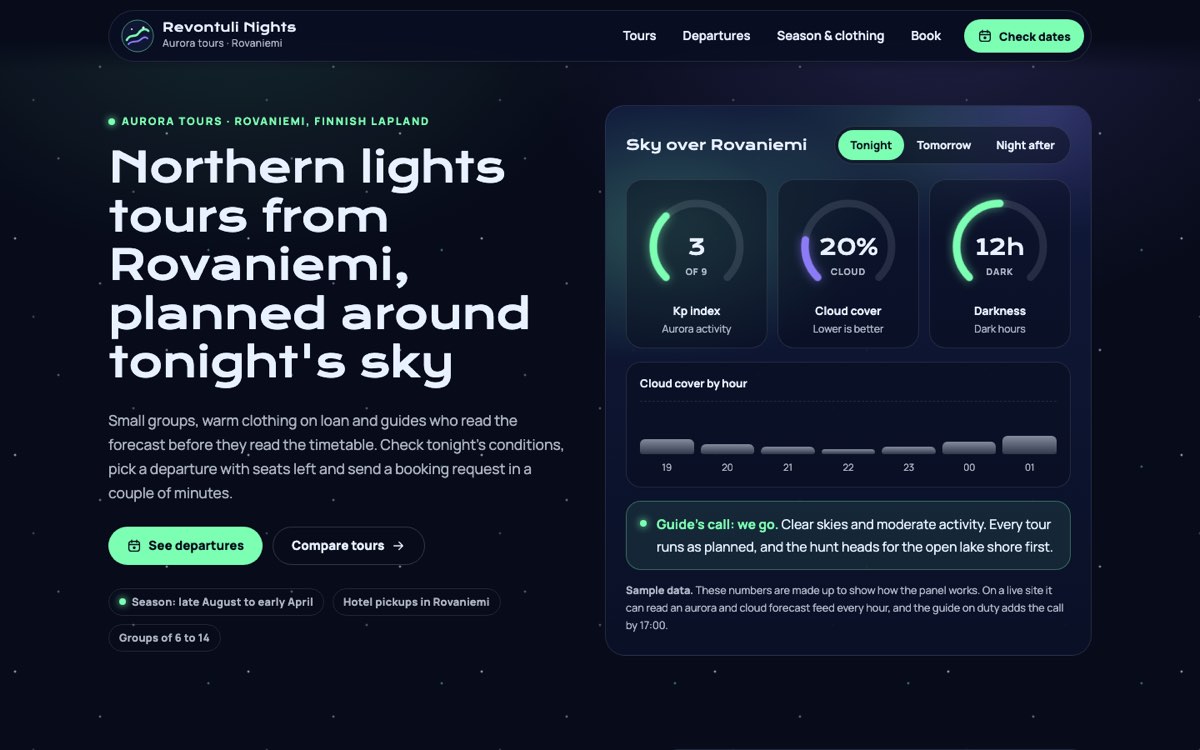
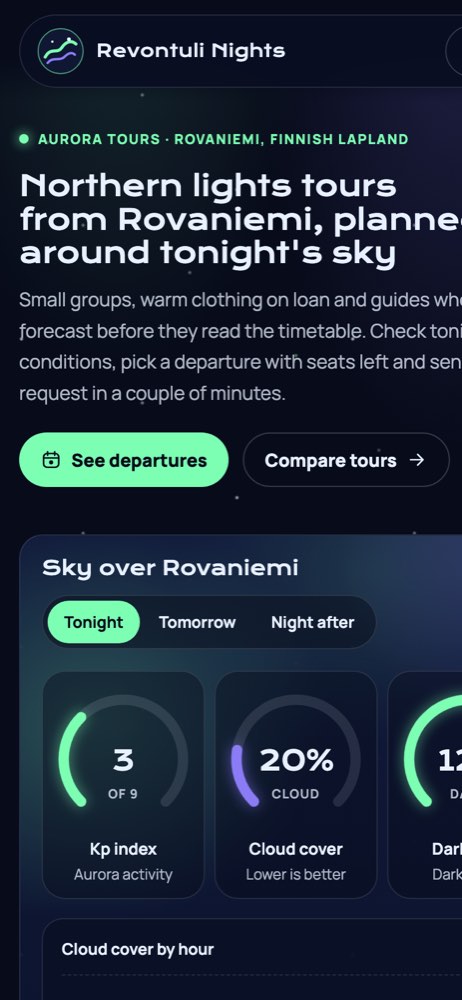
The home page opens with a panel called Sky over Rovaniemi. Visitors switch between tonight, tomorrow and the night after, and three round gauges show Kp index, cloud cover and hours of darkness. A bar chart shows cloud by hour from 19:00 to 01:00, and a short guide's call says whether the group will go, chase clearer sky or reconsider. The numbers are labeled as sample data.
The tours page covers three trips: a minibus hunt, a snowshoe walk to a lean-to campfire and a photography night for up to six guests. Each one lists its hours, group size, season, what is included, the food by the fire and the minimum age.
The departure calendar
The signature feature is the departure calendar. Each day shows the number of seats free across the selected tours, with small markers for tours that are nearly full or sold out. Past nights and nights with no departures are disabled. Visitors can switch tours on and off and move month by month through the season. The snowshoe trip only appears from December, when there is enough snow.
Picking a night lists its departures with pickup time, starting price and seats left. The Book this departure button carries the tour and date into the booking form. The form checks that the chosen tour runs on that night, keeps a sample total updated as the guest count changes and asks for pickup area, clothing sizes and children's ages.
Season and clothing
A separate page shows the season month by month, a three-layer clothing guide and seven common questions about cold, children, cameras and bad weather.
Local SEO built in
The business is marked up with schema.org TravelAgency, including its town, region, area served, currency and hours for answering bookings. Each tour is a TouristTrip with an Offer, the season page carries FAQPage markup, and inner pages have breadcrumbs. Page titles target the searches travelers make before a trip, such as northern lights tours in the town, tour dates or what to wear in Lapland.
The name, town, phone and hours match what you would enter in your Google Business Profile. Pages are static, with self-hosted fonts and inline line drawings instead of photos, so they load quickly on hotel Wi-Fi or roaming data. The Revontuli Nights pages carry no search listing because the company is fictional; a live northern lights tour site gets a sitemap, canonical URLs and a Search Console property instead.
Notes for each market
India
Aurora tourism in India is mostly outbound, so this layout suits a travel agency selling packages to Lapland, Norway or Iceland. Show prices in rupees with what the package covers, and offer a WhatsApp button, since many travelers prefer to plan by message. Deposits can be taken through UPI alongside cards.
USA
Alaska operators can use the same calendar and sky panel, with American spelling, Fahrenheit next to Celsius and dollar prices. State clearly whether taxes and gratuities are included.
Canada
Operators in Yukon, the Northwest Territories or northern Manitoba should show prices in Canadian dollars and say how tax applies. If you market to Québec or French-speaking visitors, the page structure supports a French version with its own titles.
Australia
Aurora australis trips run from Tasmania, and the forecast panel works the same way under southern skies. Use Australian spelling and dollar prices, say whether GST is included, and show your ABN in the footer.
Finland
Prices go in euros with VAT included, and the footer should carry your business ID (Y-tunnus), as the demo does. Most guests are international, so English comes first, with Finnish and sometimes Swedish versions for domestic visitors and partners. Card payments and payment links by email are the norm.
What we deliver and how the project runs
We design the site around your brand and your tours, not the demo's colors. We write or edit the content with you: tour descriptions, the weather and refund policy, what you lend and the season notes. Then we connect the parts that fill seats. The calendar can read availability from your booking system, the sky panel from a forecast feed, and requests can land in your email, WhatsApp or CRM. Our UI and UX design team works on the booking flow so it stays clear on a phone in the cold.
The project starts with a call about your tours and guests, then a design for you to review, then the build. At launch we check that the name, hours and categories on the site agree with your Google Business Profile, so the two support each other. At hand-over we show you how to update tours, dates and policies, and we offer maintenance for the season ahead.
If you want a site like this, ask us for a quote and tell us which tours you run and from where.