What homeowners look for when they choose a heat pump installer
Most people who search for a heat pump installer already know their heating bill is too high. A family in an oil-heated house from the 1980s is weighing ground source against air-to-water. Someone in a house with direct electric panels wants a quick cut in consumption and wonders whether one air-to-air unit is enough.
All of them need the same things from your website. It has to explain the difference between the systems in plain language and say which one suits which kind of house. It should give a rough idea of the saving and the payback time without promising too much. Permits, the old oil tank and the electrical connection all need a mention. Then it has to make booking a survey easy and show which towns you drive to.
How the Routaraja Lämpö demo handles it
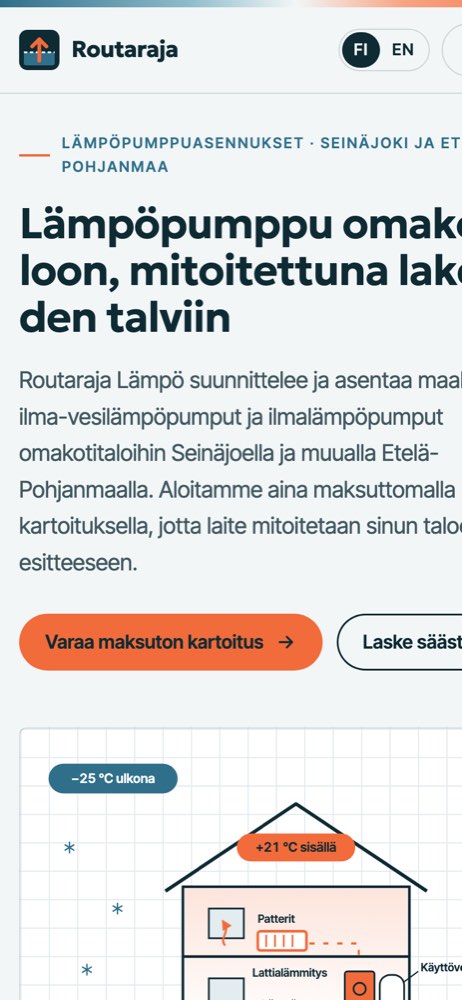
Routaraja Lämpö is a fictional installer that VirtueInfo created for this demo. It is not a client, and its phone number, business ID and prices are placeholders. The site is in Finnish and English, with Finnish at the root and English under its own path, and a switch in the header moves between the two.
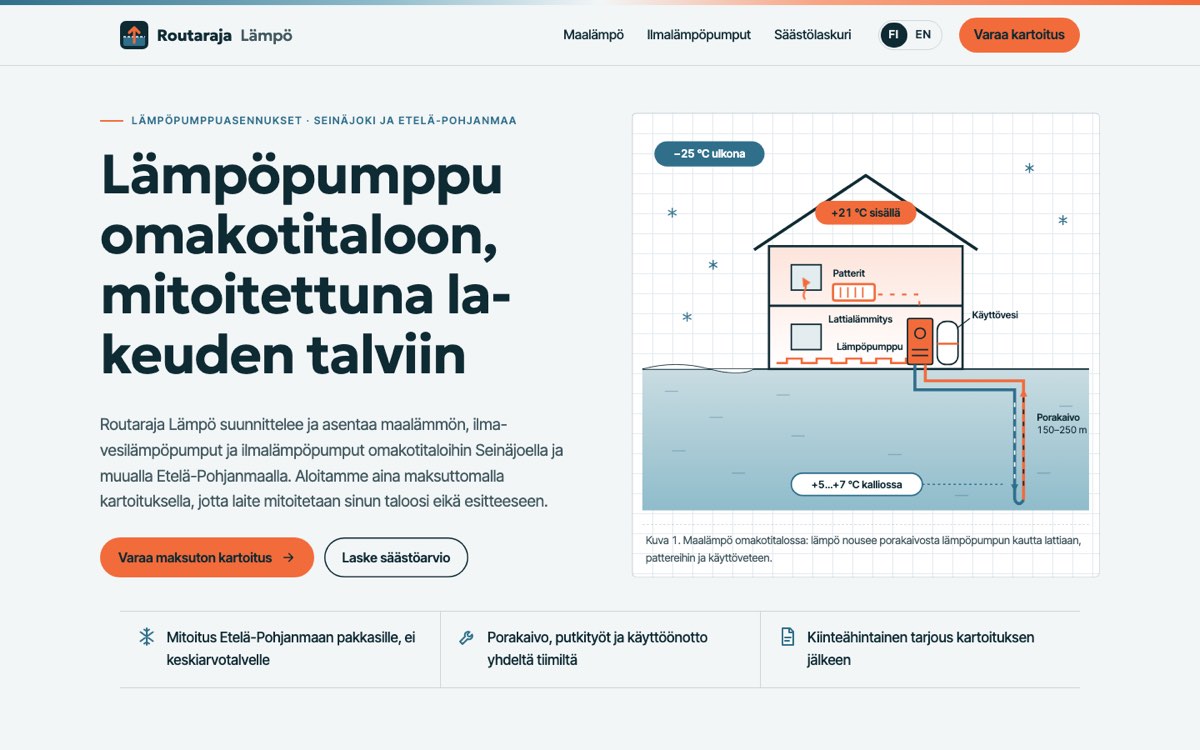
The home page introduces the three systems with a "from" price for each, then explains how ground source heat works with a cross-section drawing of a house. As the visitor scrolls through the four steps, the matching part of the drawing lights up: the borehole, the heat pump, the heat distribution and the hot water tank. Below that come the process, the municipalities covered, a short FAQ and sample reviews labelled as such.
The ground source page covers when the system makes sense, what the delivery includes, borehole depth, the municipal permit and the switch from oil in one day. The air source page compares air-to-water and air-to-air heat pumps in a table and explains frost margins and where the outdoor unit should go so defrost water drains away.
The signature feature is the savings estimator. The visitor enters the floor area, picks oil, direct electric or district heating, and gives either the yearly consumption, the yearly cost or nothing at all, in which case the size of the house is used. After choosing a system, they get a saving range and a payback range, labelled as an estimate and not a binding quote. For a house with direct electric heating it adds the cost of a water-based heat distribution system, and it says plainly when the saving would be small or negative. Every assumption is printed in a table under the result, so the homeowner can check the arithmetic.
The survey page closes the loop. Its form collects the municipality, floor area, year built, current heating, the system of interest and a preferred visit time, and it lists what to have ready for the visit.
Local SEO built in
Every page carries schema.org HVACBusiness markup with the city, region, opening hours and a list of the ten municipalities served. The system pages add Service markup with a starting price, the estimator is marked up as a web application, and the home and system pages have FAQ markup.
Page titles follow the searches people type in each language, such as "maalämpö omakotitaloon" on the Finnish ground source page and "heat pump installer Seinäjoki" on the English home page. The business name, area and opening hours match what you would put in your Google Business Profile. Fonts are self-hosted and the drawings are inline SVG, so pages load fast on a phone.
The demo pages are kept out of search results because the business is fictional. A client site launches fully indexable, with a sitemap, canonical tags and language alternates between the Finnish and English pages.
Notes for each market
Finland
Finnish comes first for most homeowners, and a Swedish version is worth planning if you work along the Ostrobothnian coast, with English as a third language. Show your business ID (Y-tunnus) in the footer and quote consumer prices in euros including VAT. Homeowners ask whether the household tax credit applies to the installation work, so the site should say how your quote shows the labour share; the demo estimator leaves the credit out on purpose. Mention that an energy well usually needs a municipal action permit and who applies for it. If you hold the registrations needed for refrigerant or electrical work, say so near the quote form.
USA
American buyers compare heat pumps by tons and SEER ratings and ask about rebates, which vary by state and utility. Use US spelling and keep incentive details on a page you can update.
Canada
Cold-climate performance is the first question in most provinces. Plan a French version if you install in Québec, and keep provincial programme details easy to change.
Australia
Australians usually call air-to-air units reverse-cycle air conditioners, and hot water heat pumps are a separate search. Use British spelling and prices in Australian dollars including GST.
India
In India heat pumps are mostly sold for water heating in hotels, hostels and hospitals. Prices in rupees with GST and a WhatsApp button for enquiries suit these buyers.
What we deliver and how the project runs
We design the site to your brand and write it around the systems you install, the towns you cover and the way you run a survey. The estimator is set up with your own price ranges, and survey requests go to your email, WhatsApp, your CRM or your booking system. We can also connect the site to search campaigns and track which pages bring in survey requests through our digital marketing services.
At handover you get training on updating prices, service areas and the estimator figures, and we can look after hosting and changes afterwards. Send us your service area and the systems you install through our contact page, and we will reply with a quote.